What if a fragment of pottery could reveal the recipe of a cacao-based drink prepared more than 2,500 years ago? At the British Museum, scientists are combining archaeology with state-of-the-art analytical chemistry to answer precisely this question.
On 24 June 2026, we had the opportunity to discover this pioneering research during a visit to the British Museum, hosted by alumna Dr Estelle Praet. A graduate of the Université libre de Bruxelles (ULB) and the University of Cambridge, Estelle is a postdoctoral researcher in the Museum's Department of Scientific Research and a key member of The Chemistry of Chocolate's Past project.
Funded by the British Academy and led by Professor Katie Sampeck (University of Reading), in collaboration with Dr Rebecca Stacey, Dr Danny Zborover and Dr Estelle Praet, the project “A new culinary archaeology of chocolate” is shedding new light on one of the world's oldest and most culturally significant foods: cacao.
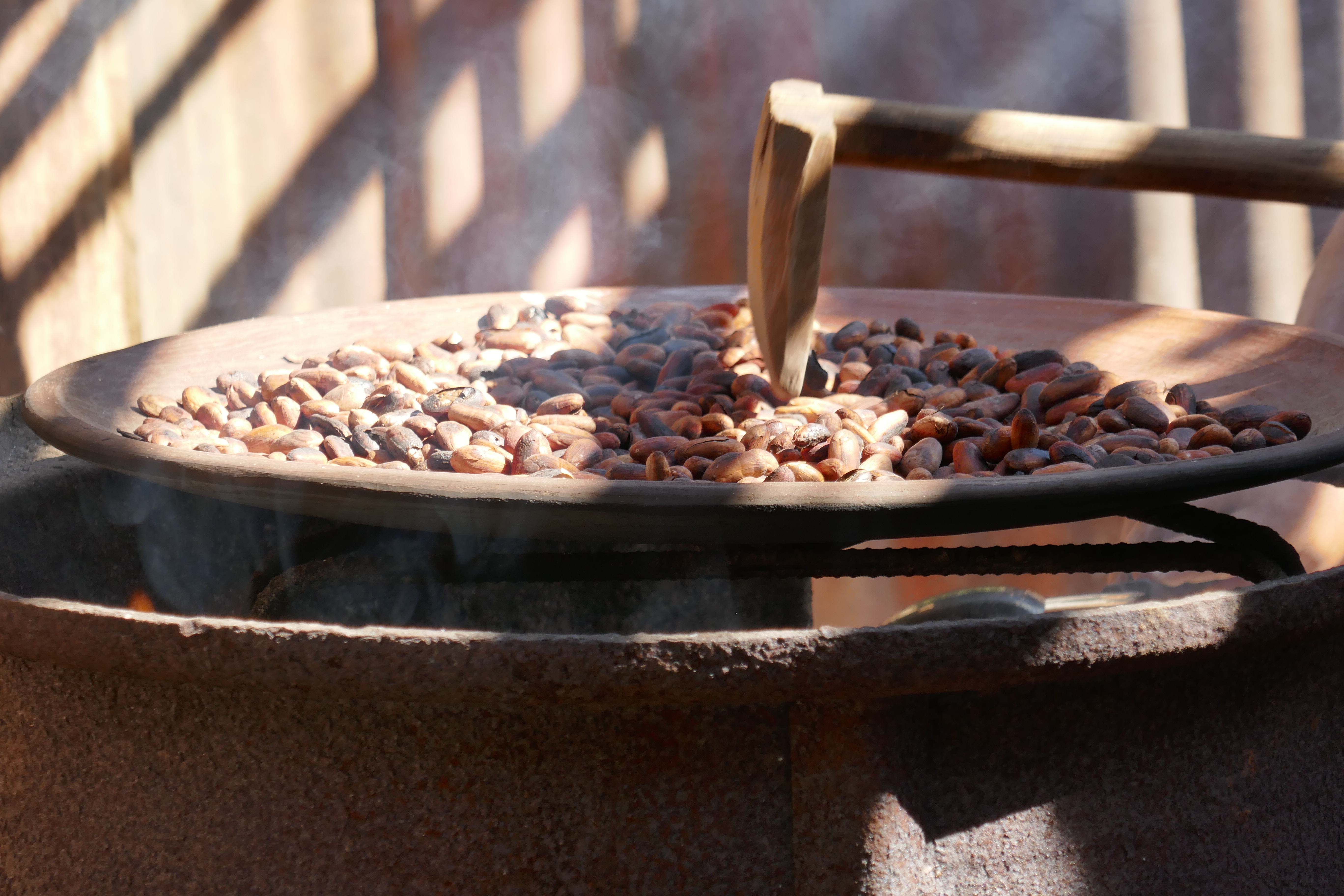
Cacao beans roasting on a comal in collaboration with the Indigenous community Cofradía Mesas de Altares Mayores, Izalco, El Salvador
Looking beyond chocolate as we know it
Chocolate has a history stretching back thousands of years. Long before it became the sweet treat familiar today, cacao played a central role in the societies of ancient Mesoamerica, where it featured in ceremonies, trade, diplomacy and everyday life.
Historical and archaeological evidence shows that cacao was consumed in many different ways. Rather than a single recipe, indigenous communities prepared and still do nowadays an impressive variety of drinks and foods using different cacao species, stages of processing and complementary ingredients. Maya inscriptions and early colonial accounts describe beverages ranging from "fruity cacao" to preparations mixed with honey, flowers or spices, illustrating a culinary diversity that has remained difficult to identify through archaeology alone.
The ambition of the project led by Professor Katie Sampeck is to move beyond simply demonstrating the presence of cacao in archaeological vessels. Instead, the research asks a far more ambitious question: how was cacao actually prepared?
Reading the molecular traces of the past
To answer this question, the research team studies organic residues absorbed into ancient ceramic vessels. Although invisible to the naked eye, these molecular traces have survived for centuries binding to the ceramic, preserving evidence of the foods and drinks once prepared inside them.
Using advanced techniques including liquid chromatography-mass spectrometry (LC-MS) and gas chromatography-mass spectrometry (GC-MS), researchers identify cacao biomarkers while analysing the broader chemical composition of residues preserved within the ceramics. These molecular signatures hold the potential to explore ingredients that may have accompanied cacao.
Rather than providing a simple yes-or-no answer to whether a vessel contained cacao, the project seeks to reconstruct ancient recipes and understand the remarkable diversity of cacao-based preparations across Mesoamerica.
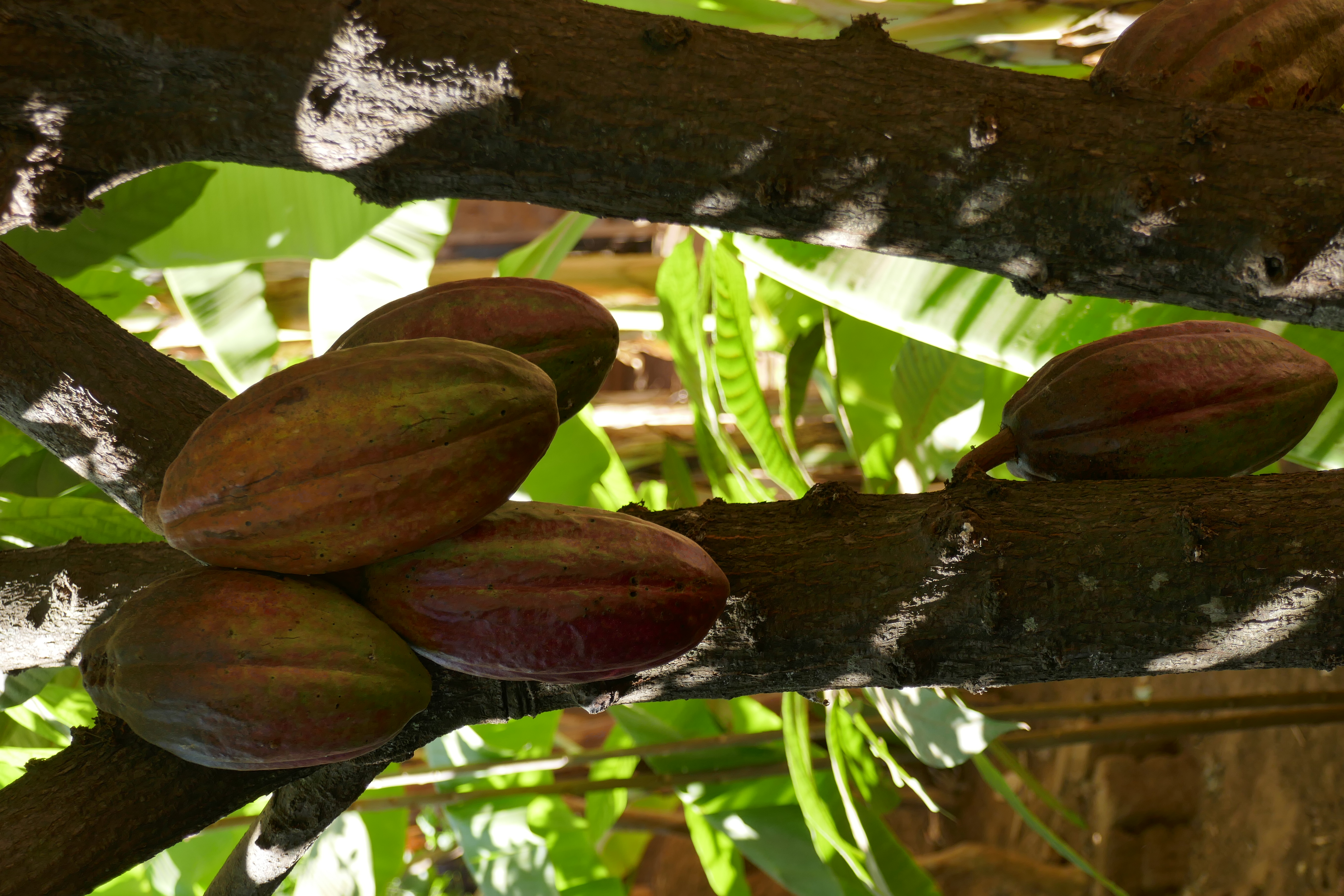
Theobroma cacao tree with pods, Izalco, El Salvador
Reconstructing culinary traditions
The research focuses particularly on archaeological material from western El Salvador, considered one of the earliest centres of the traditional chocolate production, and on ceramics from Isla de Sacrificios, an important ritual site represented in the British Museum's collections.
By combining archaeological interpretation with molecular science and insights from Indigenous communities in El Salvador and Mexico, the team is building a more nuanced understanding of how cacao was cultivated, processed and consumed over more than two millennia. Their work contributes not only to the archaeology of food but also to wider questions about trade, cultural exchange, ritual practices and agricultural knowledge in Indigenous societies.
The project demonstrates how scientific techniques are transforming archaeology. Chemical analyses that were impossible only a few decades ago are now allowing researchers to investigate ancient cuisine with an unprecedented level of detail, revealing not only what people consumed, but also how ingredients were selected, prepared and shared.
Belgian expertise contributing to international research
Among the researchers driving this work is Belgian archaeologist Dr Estelle Praet, whose academic journey began at the Université libre de Bruxelles before specialising in archaeological science at the University of Cambridge, thanks to the support of the Fondation Wiener-Anspach.
Her expertise plays an important role in identifying molecular evidence of cacao in archaeological ceramics and interpreting what these chemical signatures reveal about ancient culinary practices. Her contribution exemplifies the impact of Belgian researchers within internationally recognised research institutions, where interdisciplinary collaboration is opening new perspectives on the history of one of the world's most iconic foods.
The visit offered a fascinating insight into this intersection of archaeology, chemistry and cultural heritage, illustrating how Belgian scientific expertise continues to contribute to world-leading research in London.
More information on the project: https://www.britishmuseum.org/research/projects/chemistry-chocolates-past and on the close collaborative work with communities funded by SDCELAR: https://www.chocolateinstitute.org/post/cacao-farmers-interpret-museum-o...
Cover photo: Estelle sampling a modern reference chocolate vessel from the Indigenous Chontal community of El Guayacán, Oaxaca, México
Linked articles
Related articles

Denis Sungho: The Belgian-Korean Guitarist Connecting Europe and Asia Through Music
Europe’s next innovation valley: the Great Creative Region is in Motion
What If Biodiversity Could Be Measured Like Carbon? Meet the Walloon Innovators Turning Nature into Data